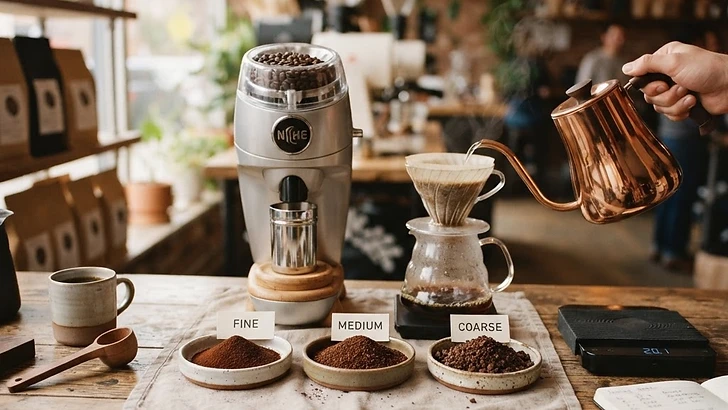
The Hidden Variable in Your Morning Brew
Most home baristas focus heavily on bean origin, water quality, and precise brew ratios. However, the most critical piece of equipment often receives the least attention: the grinder. Beyond just the fineness or coarseness of the grounds, the true performance of a grinder is measured by its 'particle distribution.' If you have ever wondered why your home brew lacks the clarity or sweetness of your favorite local cafe, the answer likely lies in the uneven size of your coffee particles.
Understanding Particle Distribution
When coffee beans are crushed, they do not break into uniform spheres. Instead, they shatter into a collection of particles of varying sizes. This range is known as particle distribution. Ideally, a high-quality grinder produces a 'unimodal' distribution—a single peak where the vast majority of particles are of a similar size.
In reality, most grinders produce a 'bimodal' or 'multimodal' distribution. This means you have large chunks of coffee alongside tiny fragments often referred to as 'fines.' While fines are sometimes desirable in specific brewing methods like espresso, an excessive amount of inconsistent grinding can wreak havoc on your brew.
The Extraction Dilemma
Extraction is the process of water pulling soluble compounds out of the coffee grounds. The surface area of a particle dictates how quickly it extracts. Smaller particles (fines) have a high surface-area-to-volume ratio, meaning they release their compounds almost instantly. Larger particles, conversely, take much longer for water to penetrate.
When your grind is inconsistent, these two groups act independently:
- Over-extraction: The fine particles extract quickly and continue to dump bitter, astringent compounds into your cup while the rest of the coffee is still brewing.
- Under-extraction: The larger particles may not fully develop, leading to a sour, thin, or 'watery' flavor.
This conflict results in a cup that is simultaneously bitter and sour—the hallmark of an uneven grind.
How It Affects Different Brewing Methods
Espresso
The high pressure of an espresso machine amplifies the issues of particle distribution. If there is a wide variance in size, the water will find the path of least resistance through the bed of coffee, leading to channeling. A consistent grind is the only way to ensure uniform resistance.
Pour-Over and Drip
For filter methods, clarity is king. An inconsistent grind introduces too many fines, which can clog the paper filter and stall the draw-down time. This prolonged contact time leads to excessive bitterness, masking the delicate floral or fruity notes that high-quality light roast coffees are known for.
French Press
Because French Press is an immersion method, it is more forgiving of coarse grounds. However, even here, a high concentration of fines can lead to a muddy cup and an unpleasant grit at the bottom of the vessel.
Evaluating Your Current Grinder
If you want to test your grinder, look at the dry grounds. Do they look uniform, or do you see visible 'dust' mixed with larger boulders? Better yet, brew the same coffee using two different grinders side-by-side. You will be surprised at how much the flavor profile shifts from muddy and heavy to clean and vibrant when you move toward a more consistent grinder.
Key takeaways
- Particle distribution refers to the variance in size of your ground coffee.
- Fines extract quickly and lead to bitterness; larger boulders lead to sour, underdeveloped flavors.
- A unimodal grind ensures even extraction and higher flavor clarity.
- High-pressure brewing methods like espresso are the most sensitive to grind inconsistency.
- Upgrading your grinder is often the most effective way to improve your home brewing quality.
Conclusion
Mastering your grind is a journey of understanding physics just as much as chemistry. By prioritizing grind consistency and minimizing the disparity between your finest and coarsest particles, you gain control over the extraction process. Whether you are pulling shots of espresso or crafting a pour-over, the goal remains the same: a balanced cup that highlights the true character of the origin. Next time you brew, pay attention to the distribution, and you might just find the missing piece of your flavor puzzle.