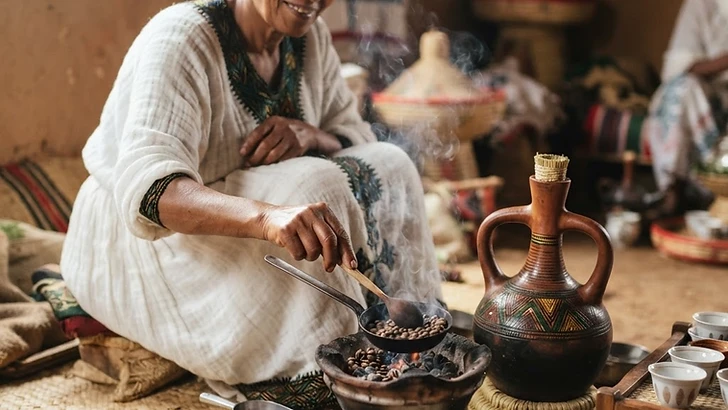
Coffee is everywhere today, but it began as a secret hidden in the forests of the Ethiopian highlands. The story of how a humble red berry became the world's favorite morning ritual is part legend, part trade history, and entirely fascinating.
A discovery in the highlands
The most famous origin story stars a 9th-century goat herder named Kaldi. According to legend, Kaldi noticed his goats dancing with energy after nibbling on bright red berries from a particular shrub. Curious, he tried them himself and felt the same lively lift. He brought the berries to a local monastery, where a monk brewed them into a drink that helped him stay awake through long evening prayers.
Whether or not Kaldi existed, the legend points to a real truth: coffee is native to Ethiopia, where people have chewed the caffeinated berries and brewed them into drinks for centuries.
From Ethiopia to the Arabian Peninsula
By the 15th century, coffee had crossed the Red Sea into Yemen, where Sufi monks used it to stay alert during nighttime devotions. The Arabs were the first to roast and boil the beans much as we do today, and they called the drink qahwa — the root of the word "coffee."
Yemen's port of Mocha became the center of the coffee trade, and for over a century the Arab world held a near-monopoly, closely guarding the plants to prevent cultivation elsewhere.
Europe falls in love
Venetian merchants brought coffee to Europe in the early 1600s. Some clergy called it the "bitter invention of Satan," but Pope Clement VIII supposedly tasted it, loved it, and gave it his blessing — clearing the way for widespread acceptance.
Coffeehouses sprang up across Europe. In London they were nicknamed "penny universities": for the price of a cup, you could join conversations with writers, scientists, and merchants. Businesses like Lloyd's of London literally began in a coffeehouse.
The new world and beyond
In 1723, a French naval officer named Gabriel de Clieu smuggled a single coffee seedling to the Caribbean island of Martinique. That one plant is believed to be the parent of millions of coffee trees across the Americas. From there, coffee spread to Brazil, Colombia, and Central America — regions that now produce most of the world's beans.
Key takeaways
- Coffee was first discovered in the Ethiopian highlands and spread to Yemen by the 1400s.
- The Arab world pioneered roasting and brewing, and guarded the trade for over a century.
- European coffeehouses became hubs of business, science, and conversation.
- A single seedling carried to the Caribbean seeded coffee across the Americas.
Every cup you drink today connects you to a thousand-year journey across continents, cultures, and centuries of curiosity.