Brewing Guides· 3 min read
A Guide to Coffee Refractometry: Measuring Strength and Extraction
Discover how coffee refractometers take the guesswork out of brewing by measuring TDS to achieve the perfect cup balance.
House Blend Cafe· 2026-10-19
Discover how coffee refractometers take the guesswork out of brewing by measuring TDS to achieve the perfect cup balance.
We're a seasonal shop, open Saturdays only.
You'll find us at the counter on Saturdays, from just after Labor Day through the Saturday before Christmas, 10 AM to 2 PM. The rest of the year we're closed. Order ahead and we'll have it waiting, or see hours and location.
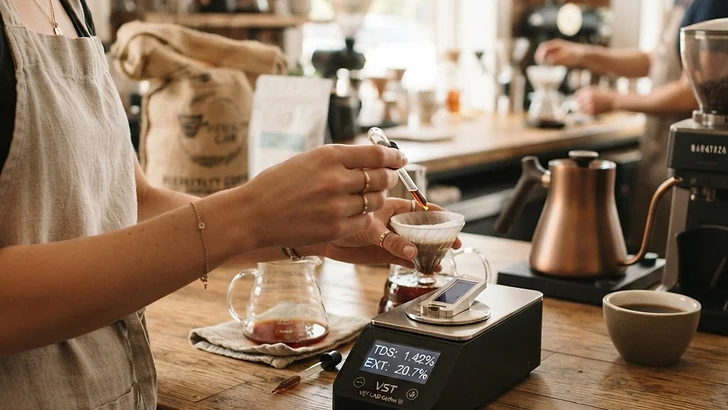
For most home brewers, dialing in the perfect cup is an exercise in trial and error. You adjust your grind, tweak the water temperature, and hope for a balanced result. But what if you could quantify exactly what is happening inside your carafe? Welcome to the world of coffee refractometry. By measuring Total Dissolved Solids (TDS), you can move beyond guesswork and into the realm of data-driven brewing.
At its core, coffee brewing is a process of extraction—pulling solubles from the bean into your water. TDS, or Total Dissolved Solids, is a measurement of how much of that coffee material is actually suspended in your final cup. A typical cup of drip coffee usually falls between 1.2% and 1.5% TDS, meaning 98.5% of your beverage is water.
While taste is subjective, strength is objective. A refractometer allows you to see if your coffee is over-extracted (too much material pulled out, leading to bitterness) or under-extracted (too little material, leading to sourness). By assigning a number to your brew, you create a baseline, allowing you to replicate your "perfect cup" every single morning.
A digital coffee refractometer works by shining light through a small sample of your brewed coffee. Because the dissolved solids change the way light bends (refraction) as it passes through the liquid, the device can accurately calculate the percentage of concentration. It is a quick, painless process that takes less than ten seconds, yet provides the data necessary to make significant adjustments to your technique.
Once you have your TDS reading, you can map it against an extraction yield chart. This chart helps you identify whether your coffee falls into the 'Ideal' zone or if it is drifting toward the 'Bitter' or 'Sour' extremes. If your TDS is too low, it suggests your water passed through the coffee too quickly or the surface area of your grounds was too low—telling you to tighten your grind size for the next brew.
It is important to distinguish between strength and extraction. Strength refers to the intensity of the flavor (how much coffee is in the water), while extraction refers to how much of the coffee bean's potential was captured. You can have a high-strength coffee that is still under-extracted, or a low-strength coffee that is perfectly balanced. A refractometer is the only tool that allows you to isolate these variables with precision.
When you find your readings are consistently falling outside the sweet spot, use this guide to make surgical adjustments:
Incorporating a refractometer into your routine is not about turning your kitchen into a clinical lab; it is about respecting the complexity of the bean. When you understand the science of your extraction, you become a better brewer. You start to see the relationship between your hand-poured stream and the final chemical makeup of the cup. While your palate will always be the final judge, having a number to back up your intuition is the fastest way to master the art of coffee at home.